
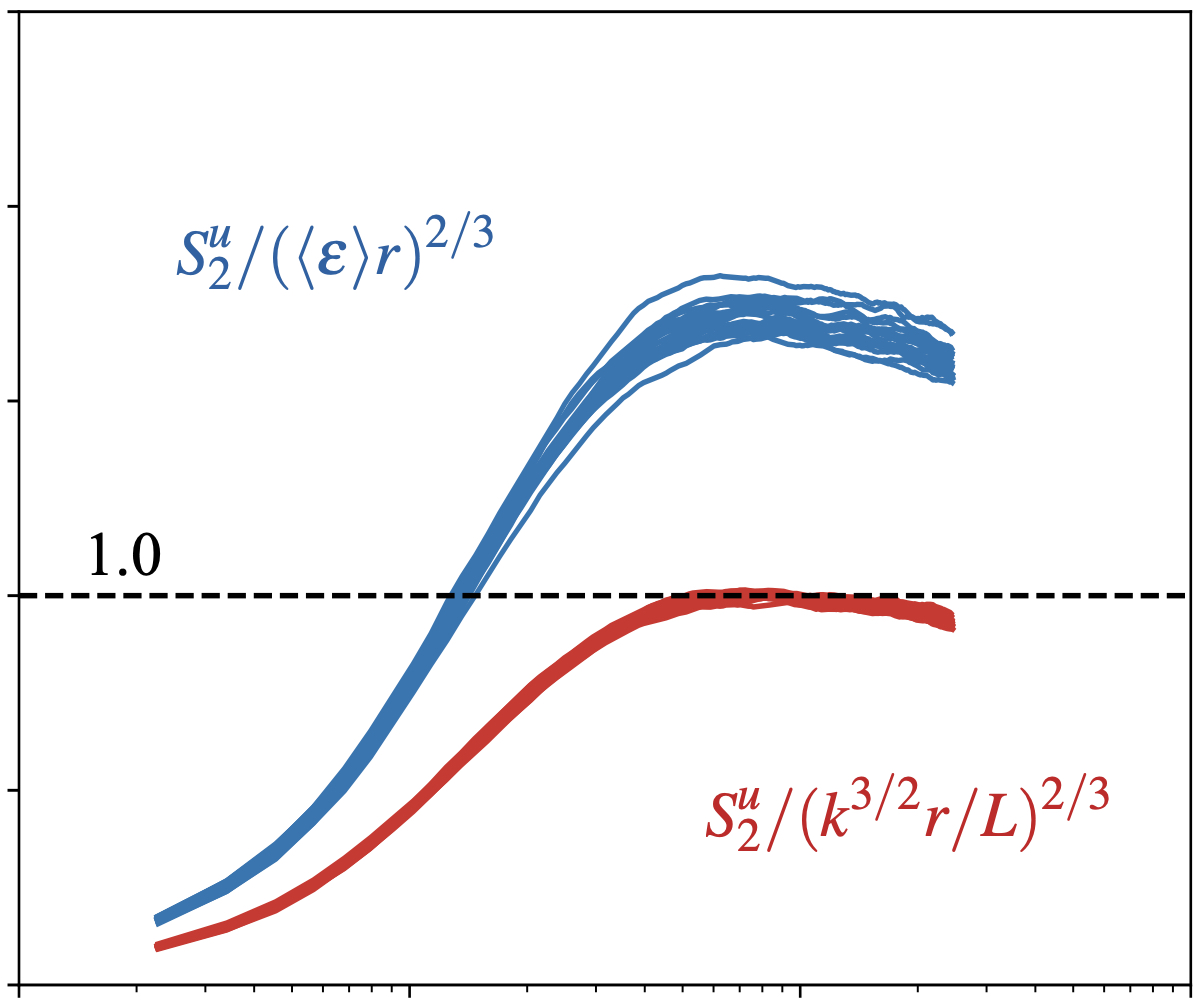
Abstract: A theory of non-homogeneous turbulence is developed and applied to boundary-free shear flows. The theory introduces assumptions of inner and outer similarity for the non-homogeneity of two-point statistics, and predicts power-law scalings of second-order structure functions that have some similarities with but also some differences from Kolmogorov scalings. These scalings arise as a consequence of these assumptions, of the general interscale and interspace energy balance, and of an inner–outer equivalence hypothesis for turbulence dissipation. They reduce to the usual Kolmogorov scalings in stationary homogeneous turbulence. Comparisons with structure function data from three qualitatively different turbulent wakes provide support for the theory’s predictions but also raise new questions for future research.
Prochains évènements
Retour à l'agendaHydrodynamic quantum analogs
Intervenant : John Bush (MIT)