
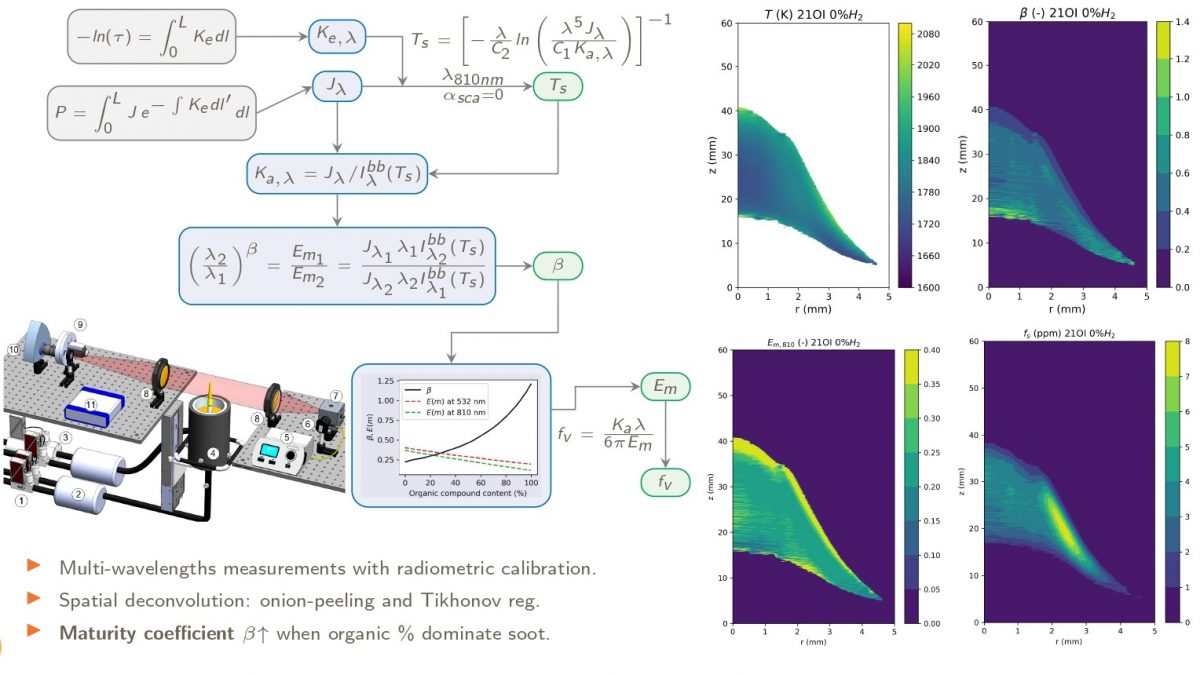
Mitigating soot emissions from hydrocarbon combustion remains a critical environmental and health challenge. Adding hydrogen to hydrocarbons reduces soot formation but can also alter particle composition and toxicity. Accurate, non-intrusive soot characterization requires knowledge of its optical properties, particularly the absorption function E(m) and the particle maturity level. Although E(m) is often treated as constant, it varies both spectrally and spatially within the flame. By combining multi-wavelength absorption and emission measurements, spatial distributions of temperature, E(m), and soot volume fraction can be obtained. Experiments in laminar diffusion flames show that hydrogen addition to ethylene non-premixed flames decreases soot concentration and radiation, while higher oxygen indices enhance soot formation. Flame temperature is governed mainly by oxygen, and hydrogen promotes soot maturation toward more graphitic particles, especially along the flame centerline under high-oxygen conditions
salle B266/B267 (Numa Manson)
1 Avenue Clément Ader
86961 Chasseneuil du Poitou
Prochains évènements
Retour à l'agendaHydrodynamic quantum analogs
Intervenant : John Bush (MIT)