
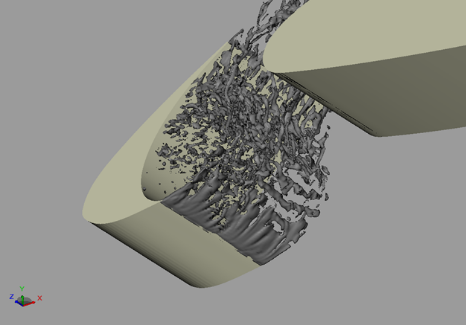
The slat is a strong noise source in airplanes and raises important environmental concern. The spectrum of slat noise is dominated by low-frequency narrow band peaks. The research to be presented initiated by acoustic wind tunnel experiments with microphone arrays and beamforming techniques. A number of slat configurations was tested. Numerical simulations were then carried out for selected cases and good agreement with acoustic results was obtained. Next, the numerical data were used to investigate the noise generation mechanisms. Innovative use of Proper Orthogonal Decomposition revealed that the tonal peak frequency selection mechanism is associated with Kelvin-Helmholtz instability resembling open cavity Rossiter modes. Improved predictions methods were then developed. The noise generation is associated with 2D structures. The path and evolution of the POD structures explain that two dimensionality is enhanced by the optimal aerodynamic design of the slat. Hence optimal aerodynamic design has the undesired consequence of increasing noise. Nevertheless, based on this results it is possible to establish guidelines the circumvent this conflicting interests, with noise reductions of the order of 10dB. The studies also involved installation aspects (such as a bulb seal), which, despite being very small, drastically alters the flow in the slat cove, reducing or increasing the noise by up to 10dB. The origin of this effect on noise is also explained.
Prochains évènements
Retour à l'agendaPrésentation d’« UTOPII »
Intervenant : Patrick ROUSSEAUX