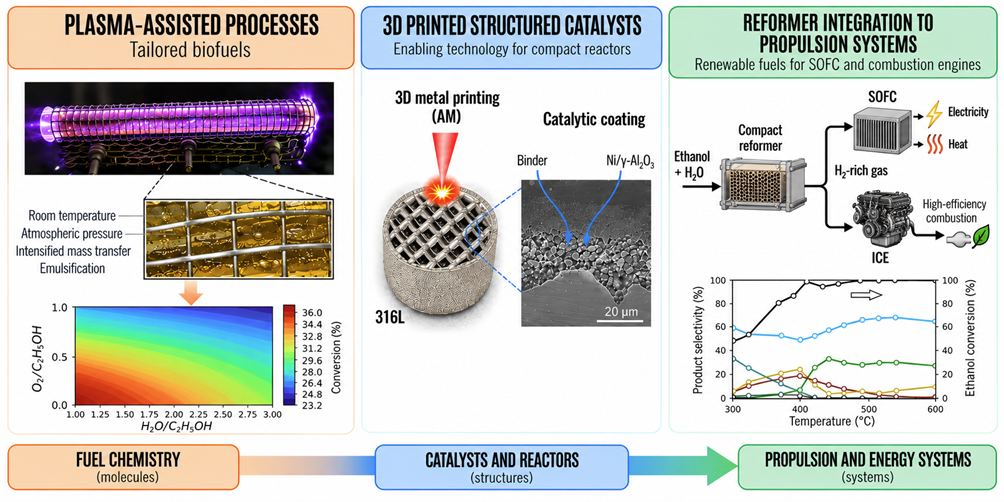
The transition towards low-carbon energy systems requires an integrated approach in which fuel chemistry, catalytic materials, reactor architecture, and process integration are developed together. This seminar presents recent research from the Applied Catalysis and Combustion Research Group (LAC/UFSC) at the Federal University of Santa Catarina, Brazil, following this perspective, from fuel synthesis to compact reactor development and integrated energy systems. The first part focuses on plasma-assisted biodiesel synthesis, exploring reaction intensification, plasma effects on oil-methanol emulsification, and the possibility of modifying the resulting FAME profile toward tailored fuel properties. The second part addresses 3D-printed structured catalysts as an enabling technology for compact reactors, combining catalyst design with controlled heat and mass transfer. Geopolymer and metallic monoliths are discussed in the context of ethanol reforming for renewable hydrogen production, together with experimental and numerical approaches to reactor development and scale-up. Finally, these concepts are extended to integrated ethanol-processing systems coupled to solid oxide fuel cells, including catalytic post-combustion, heat recovery, thermal integration, and ongoing development of reformer-in-the-loop configurations.
Salle NUMA MANSON
1 avenue Clement ADER
86360 Chasseneuil du Poitou