
The wake of a cylinder or the shear-layer over an open cavity are archetypes of resonator flows oscillating in a self-sustained fashion. The latter configuration is particularly relevant to military applications, but it is also an ideal test-bench to validate flow control methods in the lab. The aim is to suppress oscillations using a feedback loop between an actuator located at the leading-edge of the cavity and a sensor located further downstream. Self-sustained oscillations are the signature of strongly nonlinear autonomous dynamics, yet it is found numerically that full stabilization is achievable from the oscillating state, using linear tools only, without prior knowledge of the target base flow. After reviewing the heuristic method initially used in simulation, we will discuss some progress made towards its practical implementation and theoretical justification. In particular, we will present a fully data-driven version of the initial method based on the « mean transfer function » (MTF) rather than impractical linearization about a mean flow. The method is assessed numerically on the case of cylinder flow (see figure 1a). We study key properties of the MTF, in particular its close connection to linearization about a mean flow. We then investigate the MTF system identification problem on two distinct cavity flow experiments performed at ONERA and LISN (see figures 1b and 1c).
Catégorie d'événements : Fluides, Thermique et Combustion
Linear instability analysis applied to simple flame configurations
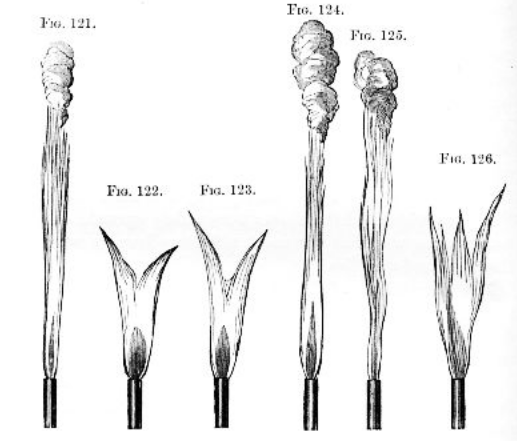
Flame dynamics involve many effects (hydrodynamics, acoustics, thermal expansion, reaction and more), and they are known to display unstable behaviour in a large variety of configurations. These instabilities can be underpinned by rich interactions, for instance between shear mechanisms, flame front dynamics and thermo-acoustic radiation. I will visit three very different scenarios where instabilities manifest themselves, and examine these with linear analysis:
1. a laminar slot flame under external excitation,
2. a V-shaped flame issuing from an annular nozzle,
3. a conical Bunsen flame of premixed hydrogen.
For the slot flame example, I will critically discuss the concept of flame transfer functions, and compare it against resolvent analysis. The V-flame displays a subcritical bifurcation due to intrinsic thermo-acoustic instability. In the hydrogen flame, linear eigenmode analysis predicts that a sub-unity Lewis number leads to the onset of « polyhedral » flame shapes.
Onset of large-scale convection in turbulent shear flows

Large-scale coherent rolls are observed frequently in unstably stratified turbulent wall-bounded flows where they strongly influence the turbulent transport and the mean flow properties. I will address the question of their genesis by means of a linear stability analysis of the turbulent mean flow where a model of turbulent Reynolds stresses is embedded in the linear stability operator. I will show that the onset of large-scale convection is associated to the linear instability of the mean flow to large-scale streamwise-uniform coherent rolls consistently with the results of recent direct numerical simulations performed in the same setting. I will also discuss the importance of including a model of the Reynolds stresses in the linear operator both in this analysis in resolvent analyses of turbulent shear flows.
In situ Raman spectroscopy of plasma electrochemical and plasma catalytic reactors
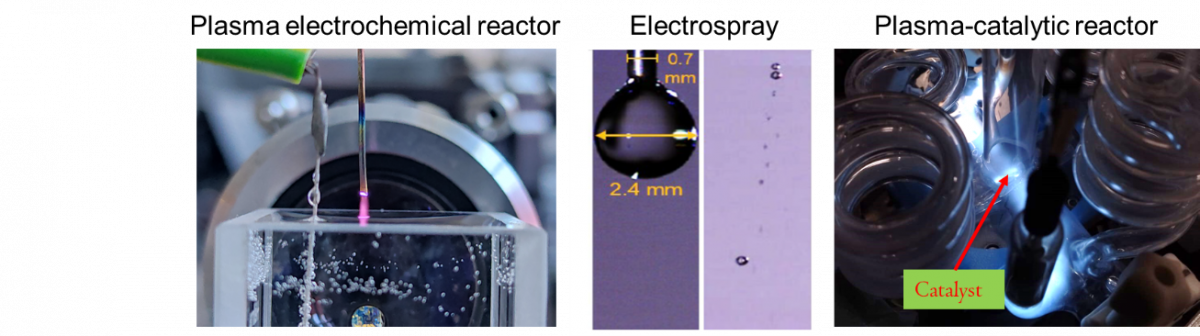
We will focus on transient changes to Raman spectra that appear in the presence of plasma, then disappear when the plasma is switched off. Such changes are observable in situ, not ex situ, and indicate the energy exchange from the plasma to water or the catalyst surface. The general approach will be to establish relationships between plasma properties and changes to the Raman spectra. Two primary cases will be studied. First, we will study PEC in air plasma-water systems at atmospheric pressure, using both batch reactor and electrospray configurations. We will focus on the spectral profile of the –OH stretch band of water and of probe molecules such as NO3 – . Analysis of the –OH stretch band reveals that the plasma weakens the hydrogen bonding network of water. To help pinpoint the cause, we will track the broadening of the N-O symmetric stretch mode (v1) of NO3 – at less than 20 µm depth from the plasma-liquid interface. Second, we will investigate a PAC reactor consisting of a low- to mediumpressure CO2 plasma in contact with CeO2 as a catalyst. In this case, the catalyst temperature will be tracked using the Stokes-to-anti-Stokes ratio of the Raman intensities of the first-order optical phonon of CeO2, as well as the spectral shift of this spectral feature.
Investigation of unsteady secondary flows and large-scale turbulence in heterogeneous turbulent boundary layers

The nature of wall-bounded turbulent flows over rough surfaces, whose roughness distribution is homogeneous, has been studied extensively and is relatively well defined. Most surfaces in nature and engineering applications, however, are heterogeneous and the heterogeneity can be arranged in an infinite number of ways. Examples include: rivets on aircraft, bio-fouling on ships, sedimentation on riverbeds, and forest and crop boundaries in the atmospheric surface layer. This talk will focus on a specific roughness arrangement composed of spanwise-alternating smooth and rough strips. Embedded within the turbulent boundary layer developing over such surface are secondary flows in the form of counter-rotating streamwise vortices. Instantaneously, these secondary flows are visually similar to the large-scale motions (LSMs/VLSMs) that occur naturally over smooth walls – both appear as elongated high- and low-momentum streaks. In this talk, I will investigate parameters affecting the formation of the secondary flows and take a closer look at the structures of turbulence in roughness-induced secondary flows, and how these structures compare to the naturally occurring LSMs/VLSMs.
The physics of birds: a story of feathers and tail
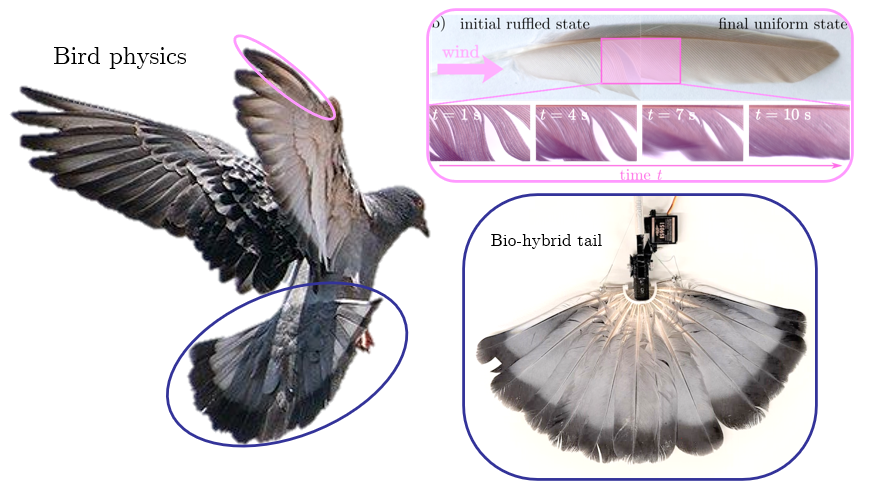
Birds are intrinsically complex physical objects, ultimately tuned for flight with light-weight highly resistant structure and optimized aerodynamic forms. From a physical point of view, birds thus offer a diversity of research interests: aerodynamic, biomechanical or even energetic. At the Biomimetics group of the University of Groningen, we investigate such aspects with follow-up developments in Engineering through drones or bio-inspired turbines. In this presentation, I will develop two ongoing projects around bird physics. First, I will dive into the biomechanical and aerodynamic properties of feathers. Then I will present how tail control in bird landing might be assisted by passive aerodynamic balance through the development of a bio-hybrid pigeon tail.
Cavitation Bubble as Microreactor: Performing Chemistry in a Bubble
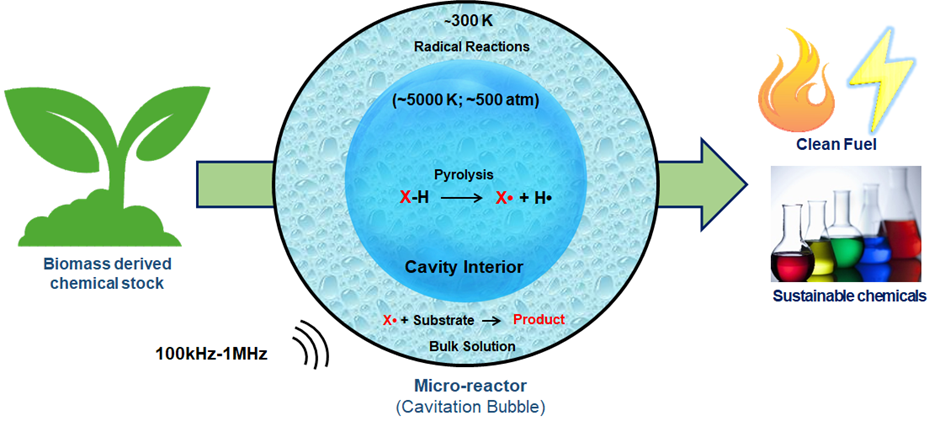
The use of unconventional activation techniques, such as low and high frequency ultrasound (US), in combination with heterogeneous catalysts offers a powerful synergistic approach to transform renewable resources to value added chemicals. Taking advantage of the cavitation bubbles generated during ultrasound irradiation which often acts as a micro-reactor and the localized extreme conditions of temperature and pressure, small molecules can be activated to yield highly reactive radicals that can in synergy with catalysis promote the selective conversion bio-based substrates into valuable products which are hitherto difficult to obtained under conventional routes and at mild reaction conditions. Through selected examples, we demonstrate the potential of high frequency ultrasound working in concert with catalysis in promoting the formation of relevant industrially valuable chemicals
Bruit d’écoulement à basse vitesse en conduit : mesure et simulations numériques
L’aéroacoustique en conduit examine la génération, la propagation et la réception du bruit généré par les fluides, en particulier dans le contexte des systèmes de ventilation, de chauffage, de climatisation et d’autres systèmes similaires. Dans de nombreuses situations, la présence d’obstacles (volet, clapet, coude…) dans la conduite rend l’écoulement turbulent. Le bruit d’obstacle occasionné se transmet au réseau aéraulique et peut constituer une gêne sonore.
La prévision ainsi que la mesure des niveaux de bruits engendrés par des écoulements turbulents en conduit est un thème de recherche qui fut initié lors du projet CEVAS (Conception d’Equipement de Ventilation d’Air Silencieux, 2013-2016) portant sur le développement d’outils de simulation et/ou moyens d’essais qui permettent de prendre en considération de manière efficace les aspects bruits en amont de la phase de conception des systèmes de ventilation d’air automobile. Le projet a permis le développement d’une formulation intégrale originale basée sur l’analogie de Ribner. La méthode ne nécessite que la connaissance du champ de pression issu d’une simulation LES incompressible sur les bords du domaine de calcul et permet de s’affranchir d’un calcul volumique coûteux. Les comparaisons de la puissance acoustique rayonnée avec les mesures, via la méthode dite ‘2N-ports’, ainsi que des mesures du champ de vitesse turbulentes au voisinage d’un obstacle inséré dans le conduit montrent de bons accords. Le cas spécifique de deux obstructions identiques séparées par une distance comparable au diamètre hydraulique montre des mécanismes de rétroaction fluide-acoustique de forte intensité. On montre que ces effets ne peuvent être capturés via la simulation numérique qu’en prenant en compte la compressibilité du fluide.
Simulation des plasmas de tokamak : états stationnaires axisymétriques à flot non nul

La détermination classique des équilibres des plasmas de tokamaks repose sur la résolution de l’équation de Grad-Shafranov. On y suppose que le plasma, vu comme un fluide conducteur, a une vitesse nulle. Expérimentalement, il existe de nombreuses observations d’une rotation spontanée dans les tokamaks notamment dans la direction toroïdale. Cette rotation du plasma s’avère avoir des effets très importants sur l’amélioration du confinement et le passage dans le mode H de confinement amélioré. Pour éclaircir ces observations expérimentales, nous nous proposons de déterminer numériquement les états stationnaires axisymétriques des équations non-linéaires de la magnétohydrodynamique visco-résistive obtenues en réintroduisant le terme convectif. Cette étude doit prendre en compte le forçage dû à la présence d’un champ électrique extérieur dans la direction toroïdale servant à créer le courant toroïdal nécessaire dans un tokamak à la création de la composante poloïdale du champ magnétique.
Numerical investigations of ship breaking bow waves

Ship bow wave breaking is a common phenomenon during navigation, involving complex multi-scale flow interactions. However, the understanding of this intense free surface flow issue is not sufficiently deep, especially regarding the lack of research on the impact of various aspects, such as scale effects, ship type effects, ship motion effects, ship speed effects, on bow wave breaking. This presentation will firstly introduce the numerical approaches for the prediction of ship breaking bow waves, where the VOF method coupling with RANS approach and Delayed Detached Eddy Simulation (DDES) method will be illustrated in detail. Two different ships, namely benchmark container ship model KCS and navy combatant model DTMB 5415 will be used in the present studies. All the numerical calculations were performed using the in-house CFD solver naoe-FOAM-SJTU, which is developed on the open source platform OpenFOAM. The present numerical approach was validated through measurement data of wave profiles and wake flows obtained from model tests conducted at CSSRC. Grid convergence study was also carried out to find a suitable mesh configuration for the simulation of ship breaking bow waves. The numerical simulations and results discussion will be divided into 4 different categories according to the simulation conditions. First is the study of the speed effects, and the breaking bow waves under different Fr conditions will be analyzed in detail. Then is the motion effect, where different trim angle conditions are considered and significant difference can be observed for the breaking phenomenon. Three different ship scale models, i.e. 1:37.89, 1:52.67 and 1:110, are applied to study the scale effects on ship breaking waves. The ship type effects on ship breaking bow waves will mainly focus on the different characteristics between KCS and DTMB. Flow field results for different conditions, including bow wave profiles, vorticity at various sections, and wake distribution, were presented and analyzed. Through various simulations and comparisons, it is found that trim angle and ship speed have much influence on the breaking phenomenon, and considerable effects of scale are observed on the temporal and spatial variations of the free surface breaking pattern. The findings of this study can serve as valuable data references for the analysis of ship bow wave breaking phenomena.