
Permanent members

Post-doctoral fellows :
PhD students :
Alisha GEORGE
Atomic scale simulations of deformations of thin nanotwinned gold films
Supervisors: Pierre Godard and Sandrine Brochard (PDP Team)
Alejandro TOLEDANO POVEDANO
Study of the magnetomechanical properties of thin films on stretchable substrates: MOKE-DRX combination
Supervisors: Pierre-Olivier Renault and Eloi Haltz (LSPM, Villetaneuse)
Noé CONDE
Functionalization of 2D sheets of transition metals (MXene) by plasma nitriding
Sous la direction de Luc Pichon et Marie Laure David (PDP)
Jules Romuald MVONDO EDOU
Study of the influence of the interface on the mechanical properties of core-shell particles by numerical simulations
Sous la direction de Julien Durinck et Julien Godet (PDP)
Vincent POIRIER
Sous la direction de Christophe Coupeau et Sophie Rousselet-Muzard (PPNa)
Funded Projects :
2026 - 2030 : ANR PRCE SELECT Stress Enhanced Local Electrical Characteristic Testing, set up development (Project coordination: Loranne Vernisse)
2023 - 2027 : ANR PRC DAMMAG Impact of mechanical damaging on magnetic nanosystems deposited on strechable substrates (Project coordination: Pierre-Olivier Renault)
International :
2022 - 2025 : ANR PRCI (France - Russie) Bisceps Biaxial Strain Control of Electronic Properties of Quantum Materials
Partners: LPS (V. Jacques, Coordinateur, France), Institut Néel, IRE-RAS / Kotelnikov Institute of Radio-engineering and Electronics of RAS (A. Sinchenko, Coordinateur, Russie), Institut P' (P.O. Renault)
2021 - 2024 : ANR PRCI (France - Autriche) NanoFilm - Nanoarchitected films for unbreakable flexible electronics
Partners: LSPM-CNRS (D. Faurie, Coordinateur, France), ESI Erich Schmid Institute of Materials Science (M.J. Cordill, Coordinateur, Autriche), Pprime Institut P' (P.O. Renault)
National :
2020 - 2024 : ANR JCJC PtyMet 3D Bragg ptychography: Developments for metallic nano-twinned thin films (Porteur : Pierre Godard)
2019 - 2023 : ANR PRC CHACAL Nano-mechanical engineering of 2D materials (Porteur : Christophe Coupeau)
2017 - 2021 : ANR PRC RODIN Rôle des disconnexions dans la plasticité liée aux joints de grains
2017 - 2020 : ANR PRCI (France - Suisse) CharADiff Caractérisation des défauts par techniques de diffraction avancées pour l'évaluation de la déformation des micro-cristaux
2017 - 2020 : DFF Mix Ti Mixed interstitial phases; a novel approach to tailoring the surface properties of titanium
Projet financé par le Danish Council for Independent Research - Collaboration avec Thomas L. Christiansen - DTU (Technical University of Denmark) - Mechanical Engineering (Department of Mechanical Engineering)
2018 - 2021 : CPER NanoTrans Nanophysique pour le Transport
Main equipments
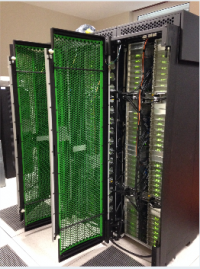
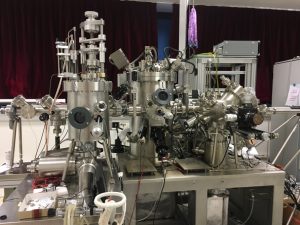
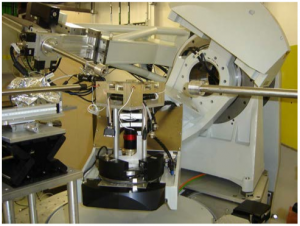
Research activities
Our research activities focus on the study of mechanical properties on the surface of various materials. Those include molecular networks, nanosheets, thin films, or microscale coatings. Our goal is to provide an advanced picture of the close relation between the structural properties, the architecture and/or the microstructure and the mechanical behaviour.
Currently, a major issue in material science is to control the mechanical properties of materials. It can be adressed through different ways: thin films or molecular deposition, coatings, surface treatments, etc. In any case, this control involves a deep understanding of the mechanical properties of these materials, including plasticity, aging, interfacial delamination, buckling, microstructure evolution. The main step is therefore to comprehend the physical phenomena occuring in the bulk (generation and propagation of crystallographic defects, diffusion of point defects) and at the surface (creation of step or complex structures, adatom diffusion).
We chose to focus our research on surfaces or close to the surface of materials. This approach has two key advantages. Firstly, we can access the low dimension effets on the usual properties. They have become more and more significant as the surface/volume ratio increases in the miniaturisation of devices in technological applications. They are also a key factor in the creation of new functional properties. Secondly, we can also better understand the physical mechanisms of the bulk as the nanostructures created at the surface are telltale clues.
Our research activities can be divided into three areas:
-
-
- Mechanical properties of nanostructed thin films: the objectives are 1. to improve the understanding of the mechanical behaviour of poly or monocrystalline thin films (few tens of nm high) sputtered on polymers and 2. to highlight the impact of the scale, the microstructure and the architecture.
- Morphological instabilities - organisation - functionalisation: the objective is to understand the fundamental phenomena related to the buckling, the delamination, the surface reconstruction though the study of the surface evolution under mecanical stress/strain fields.
- Surface modification by thermochemical treatments: the main but non exclusive objective is to improve the mechanical properties of a material using low pressure plasma assisted treatments and/or ion implantation
-
- Mechanical properties of nanosctructured thin films
- Morphological instabilities – organisation – fonctionnalisation
- Surface Modification by thermochemical treatments
- Papers
Permanent people: Eric Le Bourhis (PR UP), Pierre Godard (MdC UP), Philippe Goudeau (DR CNRS), Pierre-Olivier Renault (PR UP), Pascale Valat-Villain (MdC UP)
Context et objectives
One of the major objectives of this axis is to obtain a better understanding of the mechanical behavior of thin polycrystalline or even monocrystalline films of a few tens of nm thick deposited by spraying on polymers, and to highlight the size effects, microstructure and architecture. The thin film - polymer composite is mechanically stressed using a very original biaxial deformation machine allowing to follow in situ by X-ray diffraction the microstructural evolutions in the film, the deformation at the crystalline level and the macroscopic deformation by correlation. digital images. The experimental set-up makes it possible to measure very low relative changes in deformation (of the order of 10-5) and makes it possible to reproduce the complex deformation fields encountered by these materials in the various fields of application. The adhesion, the modes of cracking or the physical mechanisms at the origin of plasticity can be studied.
This action revolves around three research activities:
-
-
-
- Effect of microstructure on the mechanical behavior of thin metallic films
- Study of the relaxation of thin films
- Plasticity of thin monocrystalline films
-
-
These synchrotron activities were developed within the framework of an ANR Pnano Cmonano which associated Soleil and the LSPM (formerly LPMTM) of Villetaneuse for polycrystalline modeling. They come within the framework of the GDRi Mecano.
Permanent people: J. Colin (PR), C. Coupeau (PR), J. Grilhé (PR Emerit), J. Durinck (MdC), A. Cimetière (PR Emerit), L. Vernisse (MdC)
Context et objectives:
This axis is centered on studies of surface evolutions under mechanical stress fields. We aim to understand the phenomena related to buckling, delamination, the decohesion of thin films or even related to the reconstruction of surfaces. Our experimental research is based on a unique experimental tool (Nanoplast). This device in an ultra-high vacuum environment allows to monitor in situ by AFM / STM microscopy the evolution of the surface of materials under varying stresses and temperatures. The current studies are focused on two themes, understanding of the elementary plasticity mechanisms of crystalline materials, from the slip traces generated at the atomic scale on the surface, and piloting nanostructures and reconstructions of surfaces by mechanical nanoengineering under stress. The experimental approaches are closely associated with numerical simulations or models. Thus, theoretical studies on the growth kinetics of nano-objects deposited on substrates and on the evolution of delamination are undertaken in correlation with the experimental observations of the team or through external collaborations (national and international).
We are exploring five paths:
-
-
-
- Effect of plasticity on thin film buckling
- Plasticity of nanostructures
- Morphological evolution of alloys under stress
- Buckling of hyperelastic materials
- Surface nanoengineering
-
-
Permanent people : L. Pichon (Pr), J.B. Dubois (MCF), M. Drouet (IR)
Coll. DPMM-axe ENDO: P. Villechaise, J. Cormier
Context and objectives:
We are interested in surface modifications by thermochemical treatments assisted by low pressure plasma and / or by ion implantation. We have a main (but not exclusive) objective of improving mechanical properties by creating layers of compounds (nitrides, oxides, etc.) or solid insertion solutions (nitrogen, oxygen, carbon, etc.). These studies are based on two original reactors: URANOS, a treatment reactor assisted by low pressure plasma and TAPIIR, a plasma based ion implantation reactor (PBII). The aim is to understand, in connection with the processing conditions, the mechanisms of chemical and microstructural modifications and to relate them to the induced properties of interest. Employed analytical techniques enable the chemical study of surfaces and the microstructural characterization at different scales. The properties of interest are then tested within P’ or as part of external national or international collaborations. Following the first successes of nitriding at moderate temperature (<450 ° C) obtained on various FCC austenitic g-phase alloys (ASS316L, CoCrMo), the treatment of various nickel-based superalloys was undertaken from 2011 to 2018. The low temperature nitriding is today applied to the new High Entropy Alloys (HEA) containing chemical elements found in the previous studied alloys (Fe, Co, Ni, Cr…) Since 2018, plasma assisted thermochemical treatments are applied on Titanium based alloys in order to obtain thick layer of multi-interstitials (N, O, C) solid solutions as mechanical support for the very hard surface layer, within wear resistance objectives.All SIMAC papers are accessible from open access website HAL
Alumni
Postdoctoral fellows
Ibrahim GODA (01/2024 -> 10/2024) Mechanical behaviour of material surfaces under stress by numerical simulations
Qinqin XU (2024) Atomic scale simulations of twin interaction – interfaces in bimetallic multilayers Cu/Ag
Marion HURIER - 2022 - 2024 - Mechanical behaviour of material surfaces under stress
Simon SMALLEY - 2020-2023 - Mechanical behaviour of material surfaces under stress in UHV
PhDs
Romain Gautier - Grain boudary-based plasticity mechanisms in nanostructures metals - Supervisors: Christophe Coupeau and Marc Legros (CEMES - Toulouse) - Defended in 12/2021
Thibault Chommaux - Electro-mechanical behavior of indium tin oxide thin films deposited on flexible substrates - Supervisors: Pierre-Olivier Renault, Philippe Goudeau and Dominique Thiaudière (Synchrotron Soleil) - Cofunding 50% Nouvelle Aquitaine, 50% synchrotron SOLEIL (https://www.synchrotron-soleil.fr/) - Defended in 03/2023
Emmanuel Fodeke - Mechanical behaviour of 2D materials on strained substrates: experimental investigations on MoS2 - Supervisors: Christophe Coupeau and Loranne Vernisse - Defended in 06/2023
Yen Fred Woguem - Mechanical properties of nanotwinned gold thin films - Supervisors: Sandrine Brochard (PDP Team) and Pierre Godard - Defended in 11/2023
Valentin Gazagne - Study of the nitriding behaviour of FeCrNiCoAlx high entropy alloys synthetized by powder metallurgy - Supervisors: Jean Baptiste Dubois and Véronique Gauthier-Brunet (PPNa group) - Defended in 12/2023
Charlélie Chil - Mechanical behavior and stability of graphene under stress: molecular dynamics atomistic simulations - Supervisors: Christophe Coupeau and Julien Durinck - Defended in 02/2024
Hatem Benmahmoud - Magnetic properties of nanostructures on stretchable substrates: towards deformable and durable magnetoelectric systems - Supervisors: Pierre-Olivier Renault, Damien Faurie (LSPM - Sorbonne Paris Nord) and Fatih Zighem (LSPM - Sorbonne Paris Nord) - PhD cofunded by the Interactifs project (Poitiers) and the SEAM project (Sorbonne Paris Nord) - Defended in 12/24
Renaud Guenin - Microstructural characterizations of synergies between mechanical and thermochemical surface treatments applied to the metastable β titanium Ti-5553 alloy - Supervisors: Luc Pichon, Michel Drouet, et Antoine Guitton (LEM3 - Université de Lorraine) PhD cofunded by the Interactifs project (Poitiers) and the DAMAS project (Metz) - Defended in 03/25
Sohel Altaf Husain - In-situ synchrotron study of the influence of microstructure and architecture on the fracture of metallic thin films on flexible substrates - Supervisors: Pierre Olivier Renault and Damien Faurie (LSPM - Sorbonne Paris Nord) - PhD cofunded by the PRCI "NanoFilms" - Defended in 12/24
Vladimir Khoroshilov - Evolution of vicinal surfaces under strain: experimental approach and numerical approach by kinetic Monte Carlo - Supervisors: Christophe Coupeau and Vitaly L. Alperovich (Rzhanov Institute of Semiconductor Physics, Novosibirsk, Russia) - PhD funded by the Vernadski Program through the French Ambassy in the Russian Federation
Mohamed Chargaoui - Influence d’un gradient d’épaisseur sur l’endommagement par cloquage des revêtements et films minces: étude duale expérimentale et numérique - Supervisors: Christophe Coupeau and Guillaume Parry (SIMaP, Grenoble) - Defended in 01/26
Julien Drieu La Rochelle - Etude du maclage-démaclage de film mince d'or monocristallin sous rayonnement synchrotron - Sous la direction de Pierre-Olivier Renault et de Pierre Godard - Soutenue en 02/2020
Dimitri Chauraud - Influence des contraintes sur la reconstruction de l'Au (111) - Sous la direction de Christophe Coupeau et de Julien Durinck - Soutenue en 11/2019
Thierry Broult - Études des propriétés mécaniques des matériaux CdZnTe et HgCdTe et impact des déformations plastiques sur les performances électriques des photodiodes infrarouges - sous la direction de Eric Le Bourhis et de Gilles Patriarche - Soutenue en 10/2019
Benjamin Douat - Étude de surfaces sous contrainte à l'échelle atomique : application au cas du niobium - Sous la direction de Joël Bonneville et de Christophe Coupeau - Soutenue en 06/2018
Wejdene Mastouri - Caractérisation croisée de la double couche électrique se développant à l'interface solide/liquide (304L/NaCl) pour différents états de surface - Sous la direction de Luc Pichon , Sergueï Martemianov et de Anthony Thomas - Soutenue en 12/2017
Romain Boijoux - Influence de l'élasticité du substrat sur la genèse, propagation et coalescence des structures de cloquage de revêtements et films minces - Sous la direction de Christophe Coupeau et de Guillaume Parry - Soutenue en 11/2017
Sami Hamade - Influence de pliures plastiques sur la morphologie de cloques et de marches d'interface sur leur propagation - Sous la direction de Jérôme Colin et de Julien Durinck - Soutenue en 12/2016
Jean Rony Medy - Évaluation des effets de taille et d'architecture sur les propriétés mécaniques et électriques de fils composites métalliques cuivre/niobium fabriqués par déformation plastique sévère - Sous la direction de Ludovic Thilly et de Pierre-Olivier Renault - Soutenue en 12/2016
Mohamed Achraf Ben Dhia - Détermination des contraintes internes par méthode dynamique résonante : application aux massifs revêtus - Sous la direction de Christophe Coupeau, Pascal Gadaud et de Xavier Milhet - Soutenue en 12/2016
Wei He - Mechanical and microstructural properties of thin metal films on compliant substrates - sous la direction de Philippe Goudeau , Eric Le Bourhis et de Pierre-Olivier Renault - Soutenue en 09/2016
Raphaëlle Guillou - Étude in-situ des propriétés mécaniques de films minces d'or nanostructurés déposés sur substrats flexibles lors d'essais de traction biaxiale contrôlée sous rayonnement synchrotron - sous la direction de Pierre-Olivier Renault , Eric Le Bourhis et de Philippe Goudeau - Soutenue en 2015
Jonathan Michel - Caractérisation par UHV AFM/STM des nanostructures de déformation de l'intermétallique Ni3Al - Sous la direction de Christophe Coupeau et de Joël Bonneville - Soutenue en 2014
Antoine Ruffini - Influence de la plasticité sur le délaminage et le flambage de films minces déposés sur substrats - Sous la direction de Jérôme Colin et de Julien Durinck - Soutenue en 2013
Arnaud Le Priol - Métallurgie d'alliages d'interconnexion pour composants optoélectroniques - Sous la direction de Eric Le Bourhis et de Pierre-Olivier Renault - Soutenue en 2012
Soundès Djaziri - Élasticité et endommagement sous chargement bi-axial de nano-composites W/Cuen couches minces sur polyimide : apport des techniques synchrotrons - Sous la direction de Philippe Goudeau , Eric Le Bourhis et de Pierre-Olivier Renault - Soutenue en 2012
Matthieu Tatat - Influence de films fonctionnels sur les propriétés élastiques des substrats associés : application au système Ni/NiO - Sous la direction de Christophe Coupeau et de Xavier Milhet - Soutenue en 2012
Axel Richard - Étude par diffraction des rayons X des déformations induites par irradiation/implantation d'ions dans le dioxyde d'uranium - sous la direction de Philippe Goudeau et de Hervé Palancher - Soutenue en 2012
Mathieu Guerain - Contribution à l'étude des mécanismes de relaxation de contraintes dans les films de chromine formés sur Ni-30Cr et Fe-47Cr : approche multi-échelle par spectroscopie Raman et microdiffraction Synchrotron - Sous la direction de Philippe Goudeau et de Jean-Luc Grosseau-Poussard - Soutenue en 2012
Eloi Dion - Effet de la pression sur le phénomène de cloquage des films minces - Sous la direction de Christophe Coupeau et de Jérôme Colin - Soutenue en 2011
Jean-Baptiste Dubois - Conducteurs nanocomposites métalliques élaborés par déformation plastique sévère : formation et stabilité thermo-mécanique des nanostructures, propriétés induites - Sous la direction de Ludovic Thilly , Pierre-Olivier Renault et de Florence Lecouturier - Soutenue en 2010
Thi Huyen Tram Pham - Structure et propriétés mécaniques de films minces AlCrN - Sous la direction de Eric Le Bourhis et de Philippe Goudeau - Soutenue en 2010