
Présentation d’« UTOPII » (Unité Transdisciplinaire d’Orientation et de Prospective des Impacts Environnementaux de la Recherche en Ingénierie), U.A.R. CNRS N° 2049, créée en 2024, pour concevoir une méthodologie d’évaluation de l’impact environnemental des travaux de recherche du CNRS en ingénierie.
Archives : Évènements
RHAPSODI : un anneau de HAPS pour le contrôle actif du bruit de turbofan
Le contrôle actif du bruit est bien connu grâce à des produits ayant rencontré un large succès, tels que les casques à réduction active. Cependant, le contrôle actif multicanal constitue un axe de recherche ouvert, dont le contrôle actif en nacelle des bruits de turboréacteurs. Le projet RHAPSODI a été initialement motivé pour adresser le problème de l’atténuation active du bruit tonal intense rayonné par la soufflante (fan noise). Les défis sont liés au déploiement d’un grand nombre de sources d’anti-bruit et de microphones dans un environnement hostile. L’originalité de l’approche proposée réside dans le déploiement de sources acoustiques pneumatiques harmoniques (Harmonic Acoustic Pneumatic Source, HAPS) capable de générer de forts niveaux sonores. La première partie de la présentation porte sur un historique du haut-parleur à air comprimé, depuis l’auxétophone jusqu’au HAPS. Cette partie aborde la théorie et les résultats expérimentaux des HAPS, des basses fréquences (inférieures à 100 Hz) jusqu’aux ultrasons (audelà de 10 kHz), en l’absence d’écoulement et jusqu’à un nombre de Mach de 0,5.
La seconde partie traite du contrôle actif avec de multiples HAPS. La commande de chaqueHAPS nécessite de piloter l’amplitude et la phase d’une source dont la dynamique de réponse est lente. Les signaux des microphones d’erreur, situés à proximité des HAPS, doivent être corrigés des effets de champ proche. Les résultats expérimentaux en contrôle actif tonal montrent une atténuation de l’ordre de 20 dB SPL, obtenue avec un anneau de 6 HAPS sans écoulement (130 dB SWL), et avec 3 HAPS en conduit infini avec écoulement (Mach 0,5, 144 dB max).
La dernière partie met en perspective les retombées futures de ces travaux. La méthode de contrôle développée dans le cadre de RHAPSODI est adaptable à des bruits large bande, comme le montre son application récente au double vitrage actif utilisant des haut-parleurs électrodynamiques. Par ailleurs, les travaux en cours visent à accélérer la dynamique des HAPS afin de permettre une utilisation en sous-bandes. La perspective est d’explorer le contrôle actif de la directivité en champ libre.
La Background-Oriented Schlieren – Principes, Applications et Perspectives

La Background-Oriented Schlieren (BOS) est une méthode de mesure optique non intrusive aujourd’hui bien établie permettant de visualiser et quantifier les variations de masse volumique dans les écoulements fluides, notamment en aérodynamique et en aérothermique. Elle exploite la déviation des rayons lumineux induite par les gradients d’indice de réfraction présents dans un écoulement inhomogène, qui se traduit par une distorsion apparente d’un fond structuré observé par une ou plusieurs caméras.
À l’ère du numérique, cette technique constitue une évolution majeure des méthodes classiques de visualisation Schlieren, ou strioscopie. Malgré une résolution spatiale plus limitée et la nécessité d’un traitement numérique des images, la BOS présente plusieurs atouts : un dispositif expérimental relativement simple et flexible, un accès direct à des données quantitatives, et une bonne compatibilité avec des approches de reconstruction tomographique ou d’extraction modale.
Après une présentation des principes fondamentaux de la méthode, ce séminaire illustrera son potentiel à travers plusieurs cas d’étude d’écoulements complexes, notamment un jet supersonique réactif issu de la combustion de propergol solide et un jet chaud double-flux en régime subsonique compressible.
Enfin, des développements récents seront discutés, en particulier l’utilisation de techniques d’assimilation de données permettant d’inférer, à partir de mesures BOS, des informations plus riches que le seul champ de masse volumique ou d’indice de réfraction, ouvrant de nouvelles perspectives pour l’étude expérimentale des écoulements fluides.
Séminaire de l’équipe TriboLub : Lukas Dür, doctorant à TU-Graz
Lukas Dür, doctorant à TU-Graz – Institute of Thermodynamics and Sustainable Propulsion Systems (ITnA).
Efficient Hermetic Reciprocating Compressors
After a brief introduction of TU Graz and the Institute of Thermodynamics and Sustainable Propulsion Systems (ITnA) the presentation focuses on Lukas Dür’s PhD research. Using a combination of experimental and simulation approaches, the work quantifies loss mechanisms and optimization levers, delivering validated efficiency gains for compressors in domestic refrigeration systems.
Séminaire de Lucas Frérot, Institut d’Alembert, Sorbonne Université, le lundi 23/2/2026
Effets de mémoire dans les contacts rugueux : du continu au moléculaire
Bien que le modèle de frottement « de Coulomb » suppose un coefficient de frottement indépendant de la vitesse de glissement et du temps de contact, la campagne expérimentale de Coulomb a démontré l’influence de ces deux paramètres sur la force résistant le glissement entre deux solides. Depuis, ce comportement « rate-and-state » a été caractérisé pour de nombreux systèmes, notamment par Rice, Dieterich et Ruina, avec un comportement quasi-universel caractéristique : une dépendance logarithmique du frottement par rapport au temps de contact et à la vitesse. Dans ce séminaire, j’explorerai les origines de l’évolution du frottement avec le temps de contact sous le prisme du contact rugueux.
Dans un premier temps, je décrirai la dynamique d’évolution de l’aire de contact entre deux solides rugueux viscoélastiques lorsque la force normale évolue de manière non-monotone. Des expériences sur contacts entre blocs d’acrylique, menées par Sam Dillavou et Shmuel Rubinstein, démontrent l’existence d’effets mémoire à long terme et une décroissance de l’aire de contact longtemps après une diminution de la pression de contact. Je discuterai des modèles que l’on peut employer pour tenter de reproduire ces expériences, de ce qu’ils prédisent, et démontrerai ainsi l’incapacité des modèles actuels de contact rugueux viscoélastique à reproduire les effets observés expérimentalement sur l’acrylique.
Dans un second temps, je parlerai de l’évolution de la force de frottement statique au repos pour des surfaces rugueuses recouvertes d’une mono-couche d’acide gras. En alliant des simulations de dynamique moléculaire avec des résultats expérimentaux obtenus au LTDS de l’École Centrale de Lyon par Alexia Crespo, Juliette Cayer-Barrioz et Denis Mazuyer, je montrerai le rôle fondamental de la rugosité dans l’augmentation de la force de frottement, et que l’effacement de la mémoire du contact lors du glissement est liée à l’évolution des liens moléculaires entre les deux surfaces, et non à la morphologie des micro-contacts.
Séminaire du Pr. Andriy Zahorulko : Experimental and numerical studies of buffer impulse dry gas seals
Experimental and numerical studies of buffer impulse dry gas seals
For more than 30 years, gas seal technology has been a key factor in ensuring the safety and reliability of centrifugal pumps, compressors, agitators and rotary equipment in the chemical and petrochemical industries. In view of changing environmental regulations, dry gas lubrication ensures the purity of the pumped liquid medium and zero emissions of toxic substances. The non-contact function of the mechanical seal is achieved thanks to the special topography of one of the surfaces of the seal rings, which creates a gasdynamic opening force during shaft rotation, eliminating friction. Buffer dry gas seals use a regulated inert buffer gas at a pressure of 1-2 bars above the process pressure to seal the process fluid from the atmosphere. At the same time, gas seals have a minimal temperature rise and lower energy consumption than liquid seals. And the global spread of non-contact seals with gas lubrication has led to a reduction in parasitic power losses due to friction and significant energy savings.
Among the double gasdynamic seals with radial arrangement of stages, the significant advantages of buffer impulse mechanical seals are distinguished by their non-contact operation mode and hydrostatic opening force provided by the shaft rotation and periodic impulse supplying of the cavities by feeders with the buffer medium. These seals are much easier to manufacture and reliable. Therefore, in these studies, using the CFD simulation, a thermohydrodynamic analysis of a buffer impulse dry gas seals were performed. Laminar air flow was considered as well as ideal gas law, and heat transfer through the solid surfaces of the seal rings. The transient problem of the flow during the circumferential interaction of the rotor and stator gap regions was solved, which made it possible to simulate the dynamic process of supplying the buffer pressure to the cavities of the buffer impulse seal. The validity of the proposed numerical models was verified by the available experimental results on the leakages, the average temperature of the face surface of the floating ring at the exit from the seal and pressure pulsations in the cavities and on the inter-cavity land. An analysis was performed on the influence of the fixed gap size, the depth and number of cavities and the pressure difference between the buffer and sealed medium on the amplitude of pressure pulsations, the magnitude of the gap opening force, leakages and the surface average temperature of the floating ring at the exit from the seal, as well as pressure and temperature distribution along the circumference and radius of the sealing rings. The thermal and mechanical deformations of the rings and the dynamic coefficients of stiffness and damping of the buffer impulse seal were obtained.
Soutenance de thèse d’Oumaima Nakiri, intitulée « Étude du régime de lubrification mixte pour des fluides compressibles »
Hydrogen flame behavior in constant volume bomb at sub-zero temperature
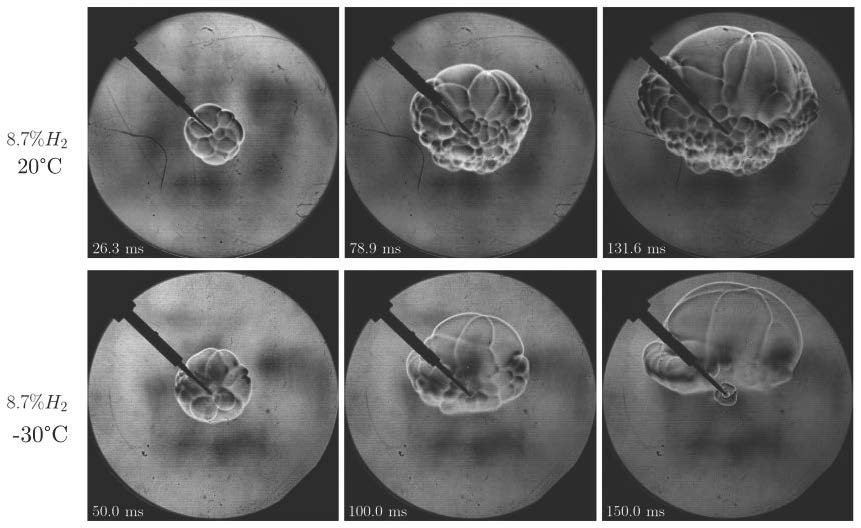
Storing hydrogen in liquid form increases its volumetric energy density, which facilitates transportation. If the confinement system of a hydrogen cryogenic tank fails, the liquid hydrogen (LH2) will vaporize and form low-temperature gaseous hydrogen (GH2). To prevent industrial risk during the storage and transportation of LH2 it is essential to characterize the flammable properties of a GH2-air cloud at low temperature. In particular, the flammability limits must be determined to ensure that the concentration of GH₂ remains below the level that could potentially lead to an explosion. Another fundamental property is the unstretch laminar burning velocity (LBV), which is intrinsic to the chemistry driving the flame propagation. Its determination has two major implications: (i) A comparison with the prediction of LBV from a kinetic model allows one to evaluate the reliability of different mechanisms (which are typically not designed to operate at low temperatures). (ii) LBV serves as a design criterion in numerous engineering applications and numerical models.
At present, only flammability limits for upward propagating flames in a tube are available (Karim et al. 1984), while laminar burning velocity (Ghosh et al. 2022) were measured within a burner for GH2-air at low temperature.
This study focus on the behavior of lean H2 mixture with air close to flammability limits as a function of temperature. We were able to design and operate a visually accessible constant volume combustion vessel to measure the impact of sub-zero temperature on flame structure. Our result highlight the influence of the mode of energy deposit on flammability limits by comparing 2 methods of arc ignition. Flame structure and over-pressure inside the vessel was recorded and showed for the first time how instabilities are impacted by the initial temperature.
Séminaire Équipe TriboLub : présentation du Professeur Andriy Zahorulko (Sumy State University, Ukraine)

Dans le cadre d’un projet Nadya financé par l’Institut Français d’Ukraine, la Cdefi et le Labex, nous accueillons le Professeur Andriy Zahorulko de Sumy State University en Ukraine au sein de l’Institut Pprime pour une période de 2 mois.
Il donnera un séminaire intitulé « Improving the sealing, lubrication, and balancing of centrifugal machine rotors with highly efficient seal and bearing designs » le 20 novembre 2025 à 14h dans la salle de réunion du D3 (1W68), batiment SP2MI H1.
Résumé et informations complémentaires: https://labex-interactifs.pprime.fr/le-labex-accueille-le-pr-andriy-zahorulko/
Insects meet wavelets: numerical modeling of flapping flight
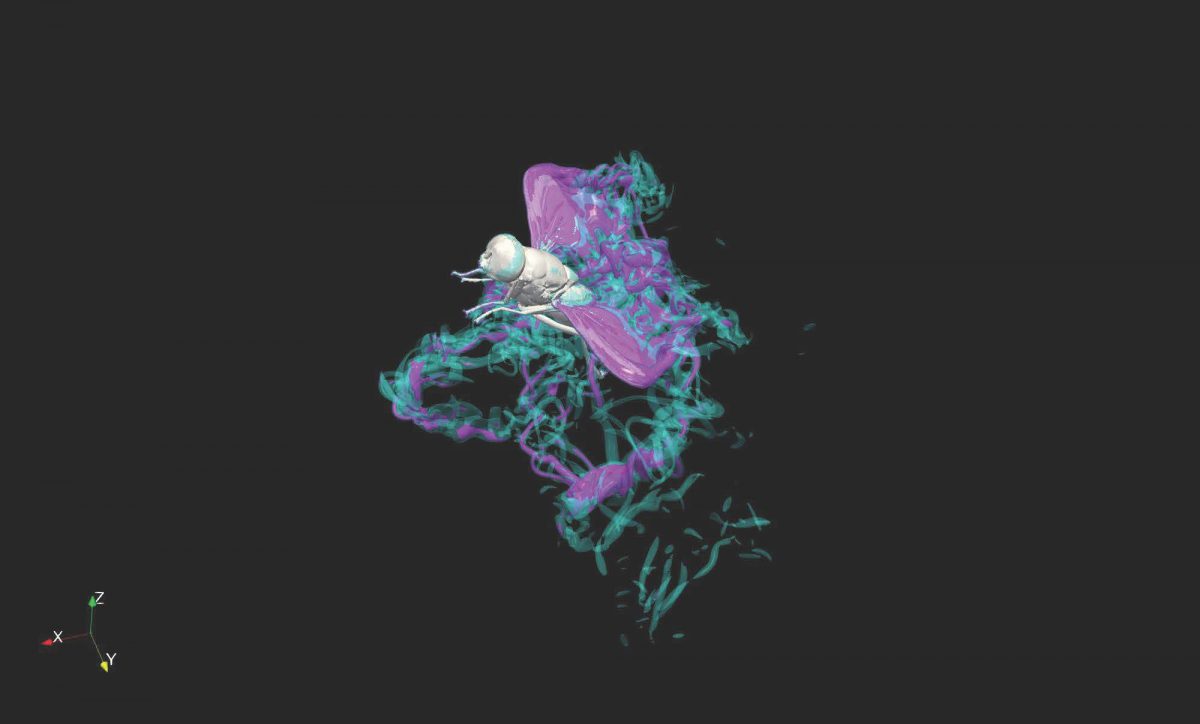
Flying insects, spectacular little flapping machines with enormous evolutionary success, are an invaluable source of inspiration for a large, interdisciplinary community of scientists. In this talk I will show our latest results on the aerodynamics of houseflies (M. domestica) and dragonflies (P. flavescens) flight with broken wings, with a focus on the numerical aspects of this work. We combine wing wear experiments, in which we study how wing damage progresses over time, with state of the art numerical simulations of the aerodynamics of animals with broken wings. The numerical simulations are done with our in-house open-source solver WABBIT, which combines wavelet-based adaptivity with an efficient parallelization to exploit massively parallel supercomputers. It will be presented in some detail in this talk. From those high-fidelity data, we obtain a data-driven quasi-steady aerodynamic model, which, combined with the full-scale simulations, allows us to explain the energetic cost of flying with broken wings. This insight allows us to draw conclusions on the reserve animals are built with, which a potentially important guideline for the design of aerial robots, as well as an important factor for biological fitness.