In 2005, Yves Couder and Emmanuel Fort discovered that droplets may self-propel along the surface of a vibrating liquid bath. Subsequently, numerous studies have shown that these walking droplets exhibit features previously thought to be exclusive to the microscopic, quantum realm. The walking-droplet system represents a macroscopic realization of wave-particle duality, and of a pilot-wave dynamics of the form proposed for microscopic quantum particles by Louis de Broglie in the 1920s. Experimental and theoretical results allow us to explore its potential and limitations as a quantum analog, and so explore the boundary between classical and quantum. Theoretical descriptions of the hydrodynamic system allow us to distinguish it from existing quantum pilot-wave theories, and explore a broader class of classical pilot-wave systems. Particular attention is given to illustrating how the non-Markovian droplet dynamics may give rise to features that are taken as evidence of nonlocality in quantum systems.
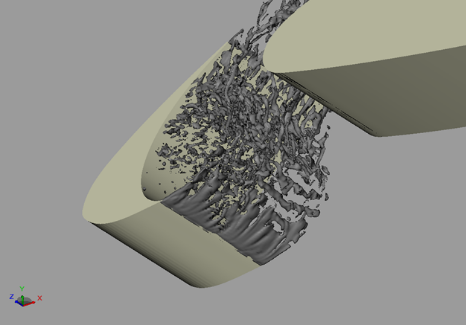
The slat is a strong noise source in airplanes and raises important environmental concern. The spectrum of slat noise is dominated by low-frequency narrow band peaks. The research to be presented initiated by acoustic wind tunnel experiments with microphone arrays and beamforming techniques. A number of slat configurations was tested. Numerical simulations were then carried out for selected cases and good agreement with acoustic results was obtained. Next, the numerical data were used to investigate the noise generation mechanisms. Innovative use of Proper Orthogonal Decomposition revealed that the tonal peak frequency selection mechanism is associated with Kelvin-Helmholtz instability resembling open cavity Rossiter modes. Improved predictions methods were then developed. The noise generation is associated with 2D structures. The path and evolution of the POD structures explain that two dimensionality is enhanced by the optimal aerodynamic design of the slat. Hence optimal aerodynamic design has the undesired consequence of increasing noise. Nevertheless, based on this results it is possible to establish guidelines the circumvent this conflicting interests, with noise reductions of the order of 10dB. The studies also involved installation aspects (such as a bulb seal), which, despite being very small, drastically alters the flow in the slat cove, reducing or increasing the noise by up to 10dB. The origin of this effect on noise is also explained.

Detonation waves are attracting increasing interest for propulsion and high-efficiency power generation, particularly for rotating detonation engines. However, predicting them remains difficult because of their highly unsteady, multidimensional nature and their sensitivity to wall effects. Until recently, a large portion of the experimental data available for simulation validation remained strongly influenced by wall effects and boundary conditions, which limited their use for isolating the intrinsic mechanisms of detonation propagation.
This presentation will summarize our recent experimental and numerical advances aimed at improving the prediction of detonation waves. It will focus on three aspects: the development of quantitative laser diagnostics applied to H2 detonations, the use of detailed
comparisons between experiments and 2D/3D simulations to strengthen the predictive capability of numerical models for H2 detonations, and preliminary work on new fuels of interest for rotating detonation engines.
Deep learning is rapidly emerging as a powerful tool for surrogate modeling and control in Computational Fluid Dynamics (CFD). Conceptually, these data-driven approaches are reshaping scientific practice, reviving the longstanding debate between data-driven and equation-based modeling. A central question is whether, and how, such methods can challenge or complement traditional CFD, which relies on well-established mathematical formulations. In this seminar, I will first outline the key principles that underpin efficient and reliable scientific modeling. I will then discuss how modern AI techniques can be designed to incorporate these principles and achieve practical effectiveness. In particular, I will highlight the role of implicit neural representations (INR) and uncertainty quantification (UQ) as critical components for robust and accurate surrogate modeling in aerospace engineering.
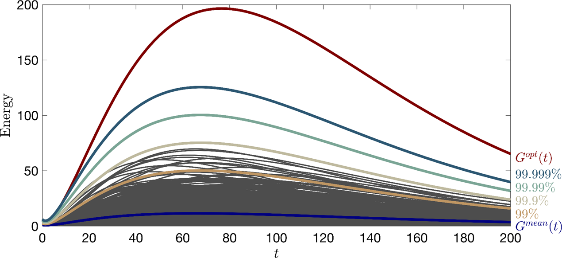
The growth of small disturbances and the subsequent transition from laminar to turbulent flow is of central importance in many engineering applications, including high-speed flight, inertial confinement fusion, and noise pollution from airplanes and wind turbines. The growth of disturbances in fluids has traditionally been characterized by their long-time asymptotic stability and, more recently, by the optimal transient (finite-time) amplification maximized over all possible initial disturbances. These descriptions, while valuable, are limited in numerous ways: the asymptotic growth or decay may emerge only on unreasonably long timescales, real disturbances typically grow much less than the finite-time optimal disturbance, and both methods rely on linearized governing equations that are not always accessible. We have developed a suite of statistical and data-driven tools to overcome these limitations and provide a more comprehensive description of the growth of disturbances in fluid systems. Given a statistical description of the initial disturbances, our framework predicts the expected (mean) growth, a hierarchy of coherent structures responsible for the expected growth, and the probability of observing any particular level of amplification, i.e., the probability density function of the evolved disturbances. Additionally, we have developed a data-driven implementation of the optimal transient growth theory that approximates the upper bound on the growth of any initial disturbance given finite data. We are currently using these new tools to develop a probabilistic transition model for hypersonic boundary layers and to assess the impact of surface imperfections of fuel capsules for inertial confinement fusion.
Space domain awareness (SDA) comprises acquiring observations and processing those observations to perform orbit determination (OD), correlation and catalogue updates, tracking, predictions, and conjunction analysis. The existing SDA infrastructure provided by the US Space Surveillance Network (SSN) and the European Space Agency (ESA) Space Surveillance and Tracking (SST) is at its limit due to the continuous growth of Earth orbiting constellations, and the projected exponential growth of orbital debris (Kessler’s syndrome). In this talk, we will present our research developing the scientific framework to achieve rapid uncertainty quantification and propagation for space domain awareness and decision making. This enables domain awareness operations on the ground as well as onboard in real-time to resolve detected objects and predict their future locations. The present rapid uncertainty quantification combines model-based approximation techniques and data-driven approaches to quantify detected/tracked objects uncertainties in real-time. Results of the proposed model-driven uncertainty propagation approach have shown 2 – 3 orders of magnitude improvement over existing methods. The data-driven approach trained on the high-fidelity model is aimed to be implemented on spaceflight hardware. Highlighted in the present algorithm are the outcomes of the collaboration with professor Razaaly via the Chateubriand Fellowship.
A hallmark of far-from-equilibrium physics is the emergence of a spectral cascade, where energy is transferred across length-scales following a simple power law. Scaling laws of steady states have been successfully predicted in fluid dynamics by the statistical theory of weak wave turbulence. However, the predictive power of this theory breaks down in presence of large amplitudes, high dissipation, and finite size effects. We offer experimental insight into these regimes by resolving the dynamics of individual wave modes in an externally driven fluid-fluid interface. We observe the time evolution of interface excitations from one to few to many, a process culminating in a direct energy cascade. Our findings confirm that interfacial dynamics can be effectively modelled by a weakly nonlinear Lagrangian theory, revealing a hierarchy in their order that confirms a key assumption of weak wave turbulence. Specific interactions are tracked through time, and we predict the timescale until a cascade emerges. Furthermore, we highlight how our experiment may inform us about other far-from-equilibrium systems by mapping our Lagrangian theory to a model of cosmological preheating in the early universe.
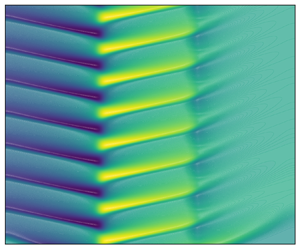
Optimal control and reinforcement learning are often viewed as competing paradigms for sequential decision-making. While model-based control relies on adjoint sensitivities, reinforcement learning derives policies through value-function approximation. However, the Hamiltonian in optimal control and the state–action value function in reinforcement learning plays analogous roles in guiding policy improvement.
This work leverages these structural correspondences to develop mechanisms of reciprocal reinforcement between modelling and control within the Reinforcement Twinning framework. In this cyber–physical architecture, a digital twin and a learning agent evolve within a shared feedback loop: the twin provides the predictive structure and sensitivity information necessary to accelerate policy optimization, while the agent generates informative trajectories that improve the model.
Illustrative test cases on nonlinear thermo-fluid systems demonstrate how policies optimized on imperfect twins can extract robust operational knowledge under stochastic disturbances. By explicitly exploiting and refining model uncertainty rather than assuming absolute fidelity, this framework demonstrates that the synergy between predictive modelling and autonomous learning outperforms their independent implementation, providing a more resilient path for the control of complex, nonlinear systems.
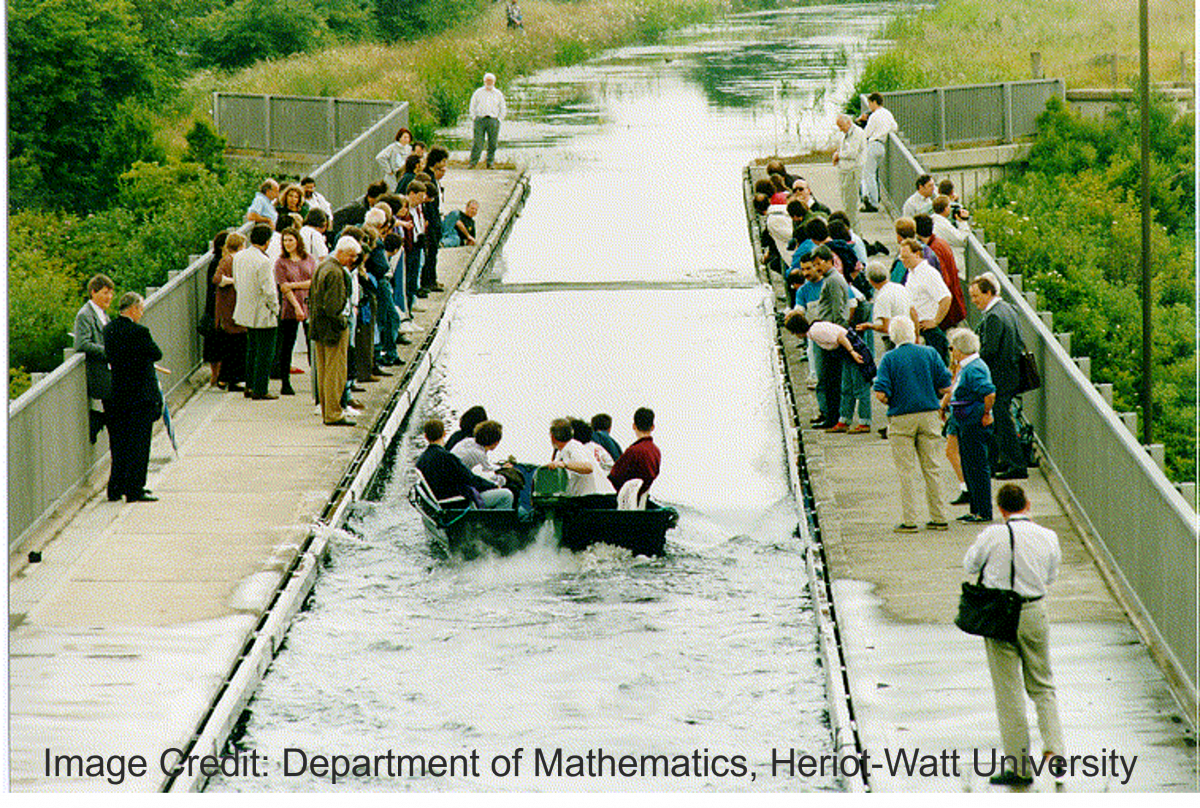
Shallow water ship hydrodynamics is a highly diverse field riddled with paradoxical individuals in its history. Where they were able to control the narrative of their stories, fame followed, and conversely, where they were unable to do so, they languished in obscurity. This talk will briefly explore the lives of two such diametrically opposed individuals, showing that although genius can come in many forms, controlling one’s narrative is what makes or breaks legacy.
After reviewing the experimental evidence for screech in a supersonic jet with and without a thin plate, we seek a minimal dynamical description capable of reproducing the observed changes in staging and spectral content. The experiments show that, in the unperturbed axisymmetric configuration, the classical sequence features an abrupt transition from mode B (flapping, standing-wave–like) to mode C (spinning, rotating-wave–like). When a plate is inserted parallel to the jet axis, this jump is suppressed and replaced by a continuous mixed response; in addition, in selected Mach number ranges the PSD exhibits two nearby spectral lines consistent with time-dependent mixed states. Motivated by these observations, we start from the resonant 1:1 Hopf normal form governing the azimuthal pair |m|=1associated with modes B and C, and introduce a symmetry-breaking perturbation representing the jet–plate interaction. The plate destroys continuous rotational invariance while preserving a reflection symmetry, thereby enabling coupling terms that are forbidden in the O(2)-equivariant case. We then classify the resulting solution branches (pure even/odd states and mixed states) and distinguish between phase-locked solutions, producing a single dominant tone, and phase-drifting (unlocked) solutions, producing a spectral line splitting through an Adler-type phase-drift mechanism. By comparing the qualitative bifurcation structure and predicted spectral signatures with the experimental PSDs, we show how the perturbed normal form naturally explains both the disappearance of the B→C jump and the emergence of mixed states. Finally, we highlight a possible amplitude-symmetry–breaking (pitchfork) bifurcation within the mixed family, providing a dynamical route to unequal-amplitude mixed states consistent with the asymmetric spectral weights measured by symmetric microphones
